

Discover the sea
The Red Sea is like a giant picture puzzle! 🐢 Find out which animals you almost always meet, which only with luck — and which three marine explorer rules you learn with us.
The animals you meet almost every time
On the reef off Hurghada they are waiting for you nearly every time. After two dives you will recognise them all by yourself — and you will even know a hand signal for each one.
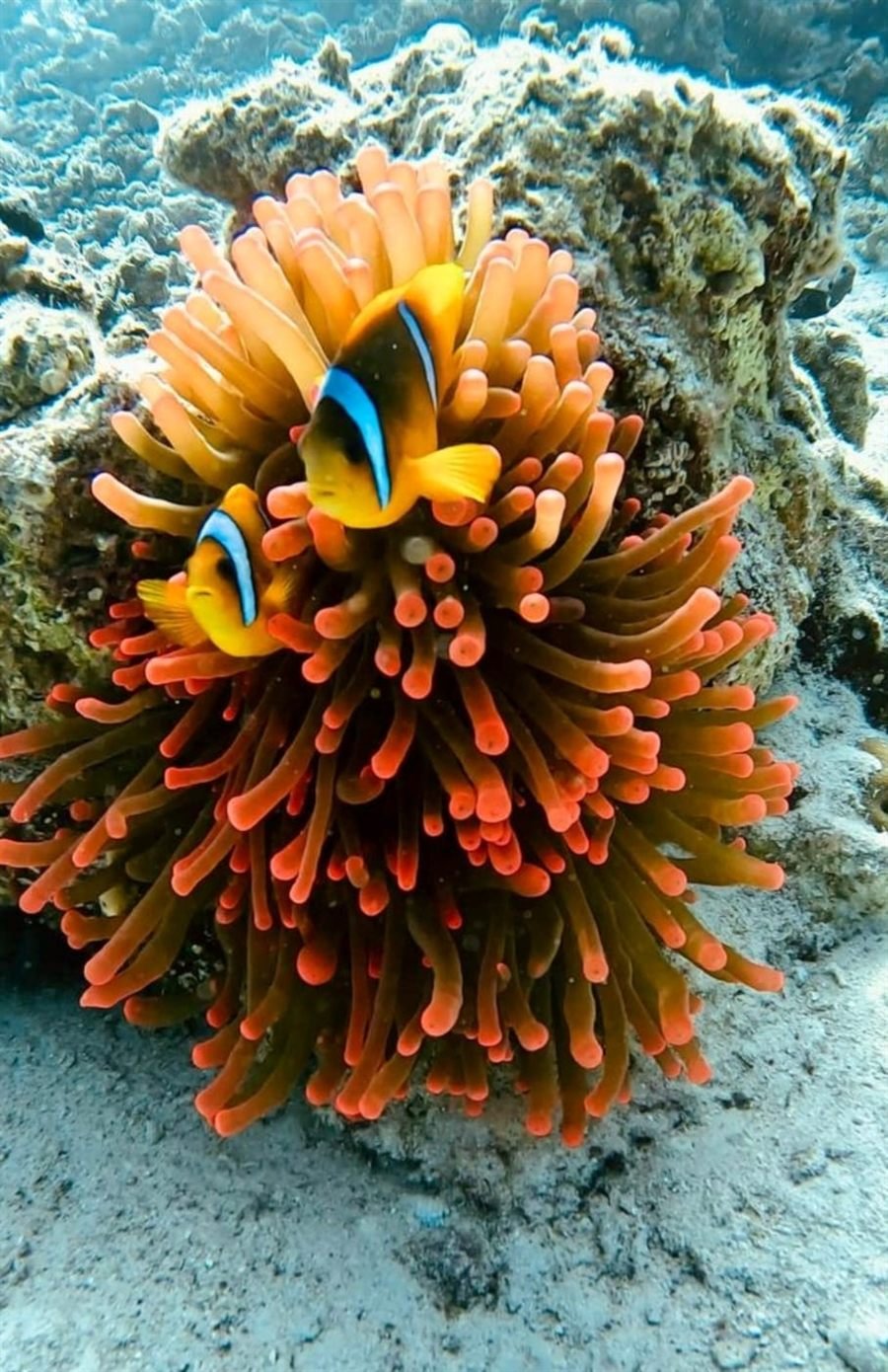
Clownfish
Lives in an anemone and defends its home really bravely — even against divers ten times its size. For many children, the first animal they recognise underwater.
Parrotfish
Brightly coloured, with a beak for nibbling coral. And here’s the best bit: what comes out the other end is sand! A large part of the white beaches on the Red Sea was once parrotfish food.
Butterflyfish
They almost always swim in pairs and stay together their whole life. Striped yellow and white, with a dark stripe over the eye — that’s meant to confuse predators.
Pufferfish
Looks like it is never in a hurry. It only puffs itself up when it is really scared — that’s why we leave it in peace, even though it would surely look funny.
Corals
Not plants but animals — tiny ones that together build a huge reef. A reef grows only a few centimetres a year. What one kick of a fin breaks takes decades to grow back.
Cuttlefish
The reef’s master of disguise: it changes colour and pattern in seconds. If you spot one, you have looked really carefully — most divers just swim straight past it.
The big encounters
You won’t see these every time — and that is exactly what makes them so special. Anyone who has met a turtle talks about nothing else back home.
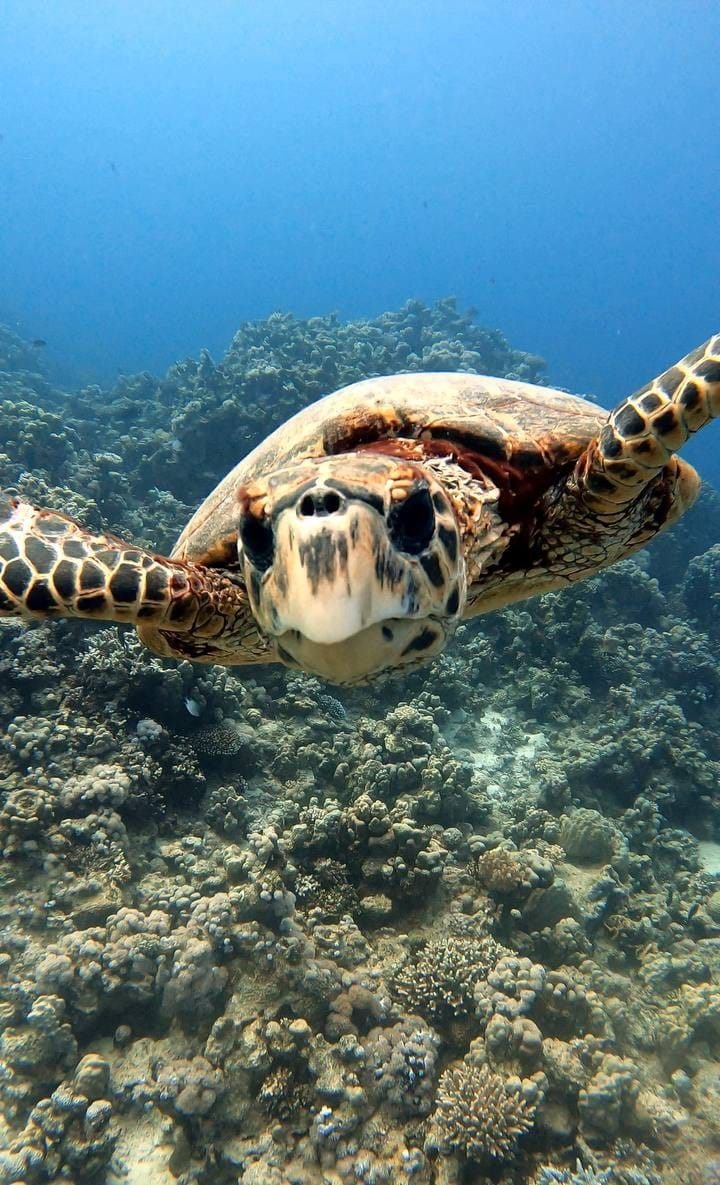
Sea turtle
Loves seagrass meadows. It hardly lets itself be disturbed — as long as you keep your distance and don’t swim after it.
Dolphins
Usually seen from the boat, jumping beside the bow wave. Underwater you rarely meet them — but if you do, you never forget it.
Rays
Blue-spotted rays hide half buried in the sand during the day. If you swim slowly and look carefully, you will find them.
Octopus
A master of hiding! Usually all that gives it away is one eye watching you from a crevice.
When a turtle swims by
It is never in a hurry. A sea turtle nibbles leisurely at the reef, swims up to breathe and comes back down. When you watch that from two metres away, everything else suddenly stops mattering.
We can’t promise you one. But we will tell you a trick: don’t swim after it! Keep your distance, keep your fins still and let the turtle decide how close it comes. Surprisingly often it then comes closer all by itself — and that is exactly why everyone remembers the rule “look, don’t touch”.
What you’d better not touch
Don’t worry, the Red Sea is not a dangerous sea. But some animals are really well camouflaged — and a few of them are venomous. That’s why our rule is always: touch nothing.
Stonefish
Looks like an overgrown stone — and is the most venomous fish in the world. Its sting hurts a lot. So: never put your hand or knee anywhere without looking carefully. Your feet stay in the water, not on the bottom.
Lionfish
Beautiful, with long, feather-like fins — and that’s exactly where the venom is. It doesn’t swim away because it isn’t afraid. Look, yes, but from a distance.
Moray eel
Peers out of a crevice with its mouth open — that looks dangerous, but it’s just how it breathes. It only bites if someone puts a hand into its hole. So: hands off holes!
Fire coral
Mustard yellow with pale tips. Touch it and you feel a burning like a stinging nettle for hours. That’s why we practise hovering so much — then you never get too close in the first place.
Sea urchins
Mostly live in shallow water. That’s why everyone wears water shoes when we enter the water from the shore.
Cone snails
Pretty shells you would love to pocket — but some have a venomous sting. On the reef everything stays where it is. Empty shells too: they are tomorrow’s homes.
The marine explorer rules
Look, don’t touch
For the animals, for the reef — and for your own fingers.
Don’t feed anything
Fish that get fed forget how to find food themselves. That’s why there is nothing to eat on the reef — not even “just a little bread”.
Take nothing
No shells, no coral, no sand. But you are welcome to collect anything that doesn’t belong in the sea — plastic, for example.
Want to see them for yourself?
On the Bubblemaker you first snorkel at the surface and then dive for 30 minutes with your very own instructor. From the Junior Open Water Diver onwards you also visit the deeper reefs.